This is default featured post 1 title

Go to Blogger edit html and find these sentences.Now replace these sentences with your own descriptions.

This is default featured post 2 title

Go to Blogger edit html and find these sentences.Now replace these sentences with your own descriptions.

This is default featured post 3 title

Go to Blogger edit html and find these sentences.Now replace these sentences with your own descriptions.

This is default featured post 4 title

Go to Blogger edit html and find these sentences.Now replace these sentences with your own descriptions.

This is default featured post 5 title

Go to Blogger edit html and find these sentences.Now replace these sentences with your own descriptions.

Showing posts with label Mekong River. Show all posts

Monday, August 23, 2010

Malaysian firm to build dam on Mekong tributary [in Laos]


Aug 23, 2010
DPA

Vientiane, Laos - A Malaysian firm has been granted permission to build a 130-megawatt dam in north-western Laos on a tributary of the Mekong River, state media reports said Monday.

Malaysia's Asia Pacific Business Lin Snd Bhd Co Ltd (AP Bizlink) last week signed an agreement with Laos' Ministry of Planning and Investment to construct the dam in Luang Namtha and Bokeo provinces over the next four years, the Vientiane Times reported.

The 145-metre-tall dam would create a 2,825-square-kilometre catchment area on the Nam Pha River, a tributary of the Mekong, South-East Asia's longest waterway, which passes through southern China, Laos, Myanmar, Thailand, Cambodia and Vietnam.

AP Bizlink chairman Zakaria bin Dato Ahmad said the project would contribute to meeting the electricity demands of northern Laos and attract foreign investment to the area.

No details were provided on the cost of the dam nor the Malaysian firm's plans for conducting a social-environmental impact study on the project area or on the Mekong.

China has already built four large hydroelectric dams on the upper Mekong, but none have yet been built on the South-East Asian segments of the river.

The Mekong River Commission - of which Cambodia, Laos, Thailand and Vietnam are members - has warned that all dams on the middle and lower Mekong River would have an adverse impact on fisheries, which provide an estimated 2 billion dollars each year in revenues for people living off the river.

'Current fish passage technology would not be effective in maintaining the migration of the large number and diverse fish species found in the Mekong,' the commission concluded in a study conducted by a group of scientists in 2008.

'In view of this conclusion and the assessment of the value of the Mekong's fisheries, the group concluded that dams on the mainstream in the middle and lower part of the Mekong will have a major impact on the fisheries and serious economic and social implications,' the commission warned.

Less research has been done on the impact of dams on tributaries of the Mekong. Communist Laos, which has said it aspires to be the 'battery of South-East Asia,' plans to build about 20 hydropower plants on its rivers by 2020.

A mountainous country rich in water resources, Laos currently has 14 hydropower plants with a combined capacity of 2,540 megawatts, much of which is exported to neighbouring Thailand.

Friday, August 20, 2010

Mekong river can be economic heart of region: Cambodia


Cambodian minister Cham Prasidh said nations around the Mekong have neglected the river itself

Cham Prasidh (right) said the Mekong should be developed for river transport to enable trade

via Khmer NZ

By Ian Timberlake (AFP)

HANOI — Nations around one of the world's great rivers, the Mekong, are tightening transport and other links but have neglected the region's very heart -- the river itself, a Cambodian minister said Friday.

At a meeting of the six countries surrounding the Mekong, Cham Prasidh said the potential of the 4,800-kilometre (2,976-mile) river has been neglected as the region develops road links and "economic corridors", which he likened to arteries.

"But we forget the heart and the Mekong River is the heart. We need to develop the heart first," he told AFP after making his suggestion to a conference of fellow ministers.

"I think this is a new concept but this is something that is going to strike them all, because we have overlooked the main thing, in the Mekong."

Cham Prasidh, Senior Minister and Minister of Commerce, was speaking at the Greater Mekong Sub-region (GMS) conference.

GMS is an Asian Development Bank-supported programme that began 18 years ago to promote development through closer economic links. Along with Cambodia it includes Laos, Myanmar, Vietnam and Thailand, as well as China's Yunnan province and the Chinese Guangxi Zhuang Autonomous Region.

Cham Prasidh said the Mekong should be developed for river transport to enable trade, while the livelihoods of people living along it should be enhanced.

He also proposed that agriculture around the river be developed in accordance with an ecosystem that is changing because of global warming.

The Mekong begins in the Tibetan Plateau, flows through China, along the northeastern border of Myanmar, and then marks the Thai-Lao frontier before pouring into the heart of Cambodia and ending at the Mekong Delta in southern Vietnam.

More than 300 million people live in the area surrounding the Mekong.

Cham Prasidh said it was too soon to assess the cost of developing the Mekong River as an economic corridor but added that it would be "quite a huge project" which he hoped the Asian Development Bank and others would support.

"Actually... the transportation of all the goods through the Mekong River should be the cheapest way of transport" once it is cleared of rocks and obstacles, he said.

"By so doing we also open the door for Laos, from being a landlocked country to open it to the sea."

No other ministers mentioned the Mekong in their opening remarks, except for Thailand's lead delegate who mentioned a need for "better management" of the river.

Delegates were expected later Friday to endorse a plan for connecting regional rail lines, which Cham Prasidh said would be another cheap way of transporting goods to the Mekong nations and beyond, to other members of the Association of Southeast Asian Nations (ASEAN).

The plan cites four possible ways of connecting the railways but it says the most viable route would stretch from Bangkok to Phnom Penh, then Ho Chi Minh City and Hanoi, and finally up to Nanning and Kunming, largely using existing lines or those already under construction.

The only missing link on that route would be between Ho Chi Minh City and Phnom Penh, it says, estimating a cost of 1.09 billion dollars for completion.

This does not include roughly seven billion dollars in additional funding needed to upgrade the existing lines.

By 2025, an estimated 3.2 million passengers and 23 million tonnes of freight are forecast for the completed route, the document says.

Although they are growing fast, the Mekong nations -- except for Thailand -- have the lowest per capita gross domestic product among the 10 ASEAN members.

Thursday, August 19, 2010

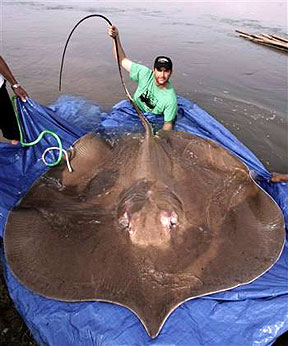
Giant Mekong species


Thursday, August 12, 2010

Mekong in danger of soon becoming 'Chinese river'


Mekong Tipping Point from Henry L. Stimson Center on Vimeo.


August 13, 2010
DPA

Plans to build hydropower dams on the upper Mekong will turn Southeast Asia's longest waterway into a "Chinese river", the regional head of the US-based Stimson Centre has warned.

China has already built four hydropower dams on the upper Mekong River in Yunnan province and plans another four, despite the unknown impact on downstream nations Thailand, Cambodia, Laos, Burma and Vietnam.

"Unless all six countries get together and work through this issue, the likelihood is this river will become a Chinese river," said Richard Cronin, who heads the Southeast programme of the Stimson Centre, a US-based think tank that focuses on global security issues.

The centre recently published a paper titled Mekong Tipping Point that highlights the human security and political instability threats posed by the four planned hydropower stations in China and 11 on the lower Mekong.

Past efforts to build hydropower dams were hampered by the Vietnam War in the 1960s and '70s, and thereafter by multilateral bickering.

China, however, has built a cascade of dams on the upper reaches of the river, primarily for electricity generation.

"Ideally, China should stop with the four dams it has built, operate them with transparency, and the dams should not be built on the lower Mekong," Cronin said.

He warned that if China's cascade of dams was built, they could halt up to 70 per cent of the silt that is normally carried by the river to the lower Mekong countries, depriving them of nutrients.

Dams built on the lower Mekong would have an even greater impact on food security.

The Mekong, which flows from the Tibetan Plateau to southern Vietnam, rivals the Amazon in terms of the quantity of fish and aquaculture, and feeds and employs up to 60 million people in the region.

Dams in southern Laos and Cambodia would have an immediate impact on the migratory patterns of fisheries, the study warned.

China's upstream dams became a political issue earlier this year, when the entire region suffered a severe drought. Several non-governmental organisations blamed China for exacerbating the drought by controlling the river's flow.

China refuted the accusations, providing data on its dams' intake and outflow during the period, but it has yet to devise a transparent system by which Southeast Asia is kept appraised of its upriver activities.

Share

Twitter Delicious Facebook Digg Stumbleupon Favorites More